
Singapore (1969)
Inner city harbor & Sago Lane

Singapore, Inner city harbor

The barges unloaded the ships anchored outside, and the barges were unloaded in the city harbor.

Two men carrying boxes on their heads in a busy street.

The Inner city harbor stank, especially at low tide.

Many who worked in the harbor were illiterate. But there was the story teller. Nearly every evening he could be found at the harbor front, reading the latest news or telling tales of bygone glorious times.

Terrace houses

A black and white photo of an elderly man with a beard, short hair, and a gentle smile, standing outdoors.
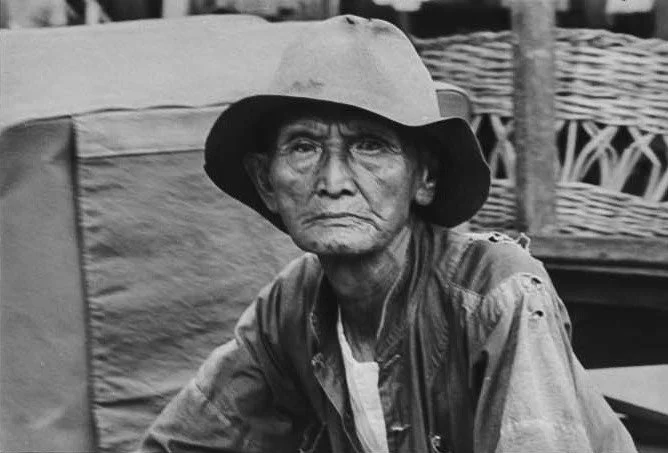
Black and white photo of an elderly man wearing a wide-brimmed hat and a leather jacket, sitting outdoors.

Sago Lane, noodle soup stall.

Sago Lane. Those noodles are slippery.

A young Chinese girl eating ramen soup with chopsticks and a spoon at a table. | Sago Lane, Singapore. | 1969

Sago Lane. A Chinese girl eating a noodle soup.

Sago Lane, a coffin maker.

Sago Lane, closing a 'door'

Sago Lane, lifting a coffin onto a funeral truck.

A group of Taost priests dressed in traditional |1969 robes participating in a religious ceremony or ritual indoors.| Sago Lane, Singapore. |1969
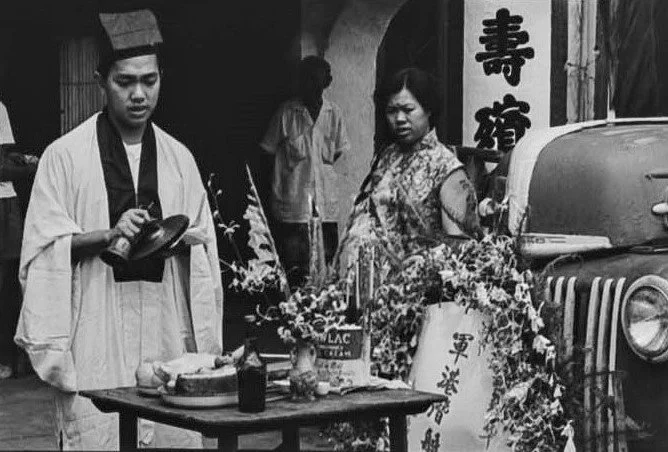
Taoist priest
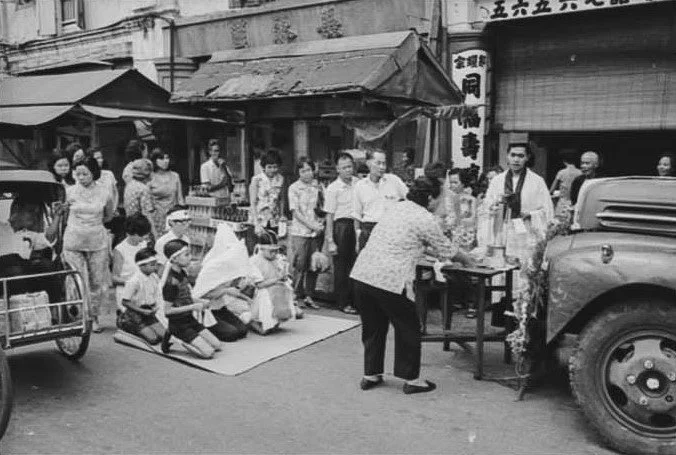
Sago Lane, a Taoist funeral

Sago Lane, a young family member of the deceased.

A young Chinese boy with a Taoist ritual headband and wearing a padded vest, with a concerned woman applying something to his chest. | Sago Lane | Singapore | 1969

Sago Lane, a Taoist funeral. Musicians playing instruments in front of the funeral truck.

Sago Lane. The funerals were quite noisy.

Sago Lane. A Taoist funeral. Musicians led the procession.

Funeral parlor. Part restaurant for the bereaved.

Sago Lane. Effigies of cars, houses and money were burned to accompany the deceased.

Sago Lane. Poverty and opium addiction, leftovers from British colonialism.
Singapore
In 1967, when I first arrived in Singapore, it was still a free-for-all town. Lots of poverty, there were still opium dens and other drugs were readily available. Long-haired hippies were the norm, as were spitting and chewing gum on the soles of your shoes. Every record shop would copy your favorite music on a mini cassette. Singapore was a town, where you worked and died on the sidewalk, in between you ate and played on the streets. The inner harbor was filthy, sampans still transported food and other goods to the city. The harbor was a 'world of dog eat dog', of drugs, of extreme poverty, of rats and garbage; of illiteracy and not far away: extreme wealth; international banks everywhere.
The children of Singapore experienced in the late sixties the start of a new era: Prime Minister Lee Kuan Yew worked hard to give Singapore a new face; slowly, the city changed.
By 1970, most of the opium dens were closed, (a few were allowed to remain open, under strict supervision to serve the elderly opium addicts.) Any male, whose hair reached over his shirt collar, received a compulsory instant haircut. A New Zealand cricket team was stopped at the Malaysia Singapore causeway, they were not allowed entry into Singapore, till they received a haircut. Male tourists, arriving at the Changi airport with long hair were denied entry unless they agreed to a haircut. When Pierre Trudeau, the Prime Minister of Canada at the time, was being interviewed by the local press, he was only allowed to be photographed from the front, hiding his ponytail.